Johannes Brahms (1833-1897) was a well-known composer in Vienna in 1875, but had yet to achieve widespread fame and recognition in the classical world. This would drastically change in 1876 when he premiered his first symphony, which he had been working on since 1868 and which was modelled on what was then the most recognised symphony: Beethoven's 5th. It was premiered in Karlsruhe, conducted by Brahms' close friend Felix Otto Dessoff.
In what follows, I will take a closer look at the first part of the first movement, as this is where we are presented with the material that will be worked through in the rest of the movement. First there is a long introduction that establishes the tonality, C minor, but in bar 38 the tempo and intensity increases and shortly afterwards the violins present the first theme of the movement:
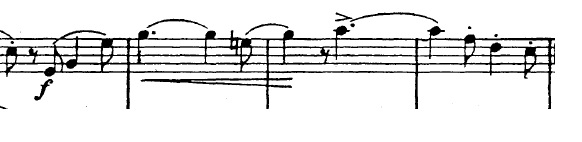
After a slight reworking of this theme, it returns, now moved up into bassoons and clarinets. Notice how the accompaniment in the strings is radically different, much more dak-dak-dak-dak than the dynamic da-di-di-da-di we heard before:
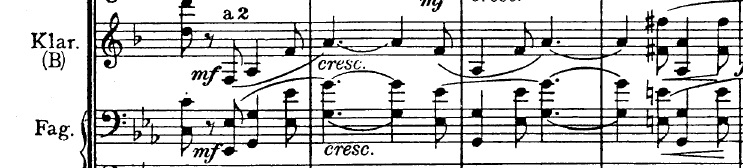
Brahms first lets the intensity rise to an extreme, then he lets it fall apart completely and the music is almost allowed to die down. Out of the silence, we hear a flute starting things up again and the violins play a variation on the first theme, where instead of continuing upwards, it goes up and then down again:
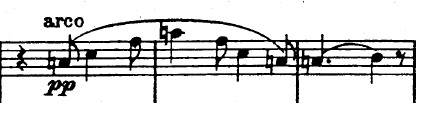
However, he doesn't let go of the theme completely, but instead lets it function as a transition, where it is first played in cello and then moved to violin as a variation:
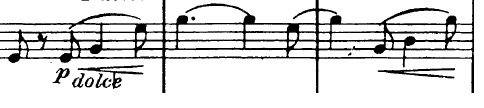
The violin's vatiation is barely over before we are led directly into theme no. 2, here played by the oboe:

This melody quickly develops into a game between the oboe and clarinet:

The game dies down before the clarinet begins again, and this time the horn and flute also join in:
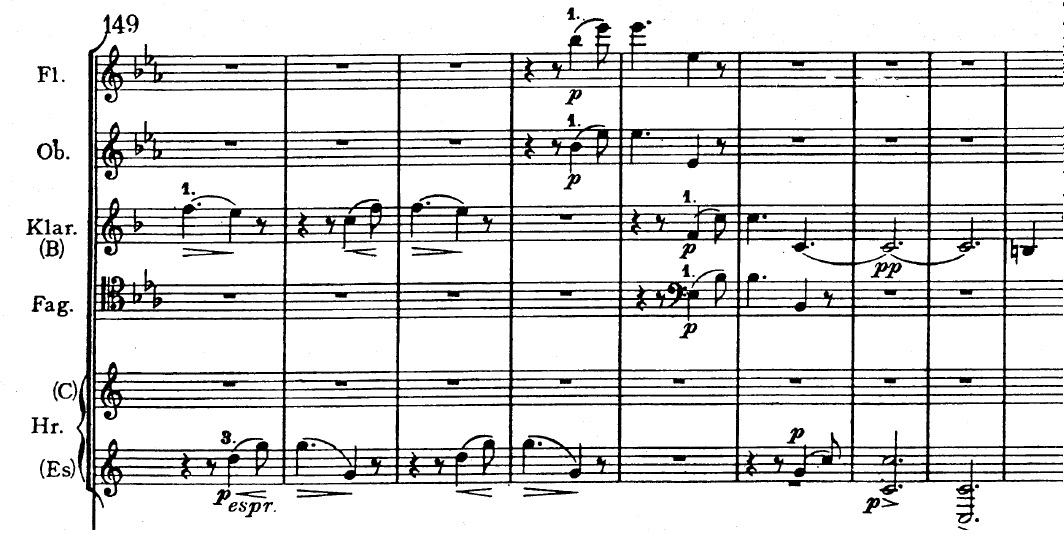
Theme no. 2 barely has time to die away before the violas begin the third and final theme, a descending figure of three notes, which the violin soon takes over and the viola immediately responds to:
The intensity increases dramatically in the following piece, but we are briefly introduced to the first two themes in the jumble. First theme 1, or at least an echo of it, in the low strings:
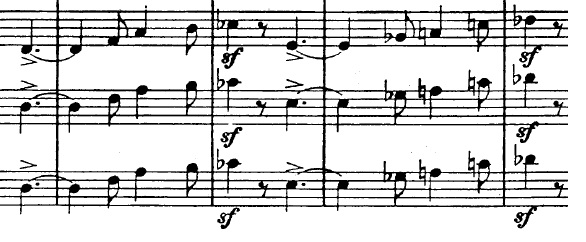
And at the very end, I can't help but hear a fusion between theme 1 and the game from theme 2, where the instruments repeat phrases from each other:
These three overarching themes will be taken apart and put together in a number of different ways in the following, but now you have an introduction to what it is good to listen for.