Franz Schubert's (1797-1828) 4th Symphony in C minor is the last of his four youthful symphonies and was completed in 1816, when he was 19 years old. However, it would be a long time before it was finally performed in public, as this only happened in 1849. Schubert was relatively unknown outside of his circle of close friends in Vienna, but after his death at the age of 31, many of the great composers of the time took up his music and presented it as something special. Schubert's musical style falls somewhere in the middle of the transition from Viennese Classicism to Romanticism, but his youthful works are still very much characterised by Viennese Classicism, with many repetitions.
In the following, I will go through the last movement of the symphony, labelled allegro - quickly!
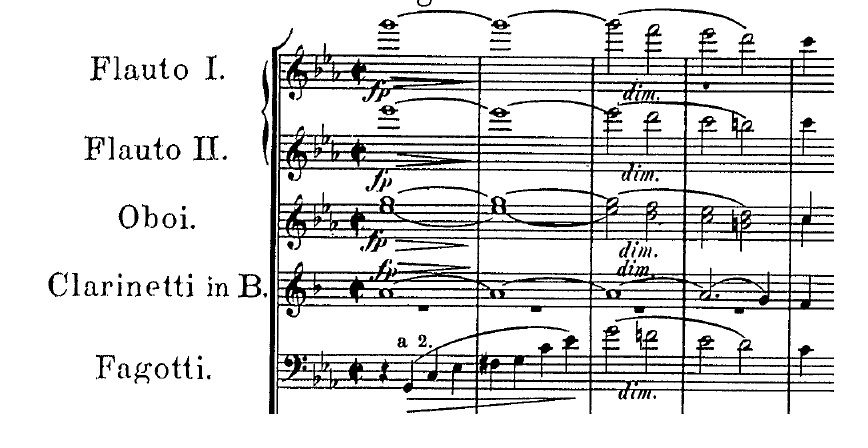
The movement opens with a C minor chord spread out in the woodwinds, while the bassoon plays a broken C minor ascending - this is released in a descending movement:
Immediately, the violins introduce us to the central figure of this movement, which consists of a long note and then a series of leaps that orbit this note. First we hear it orbiting C:
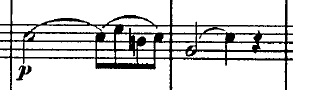
This figure is then moved up a note and orbits D, and in the following Schubert remains in variations on this figure until he chooses to break it and instead creates a figure based on an upward movement, first in steps and then in leaps:

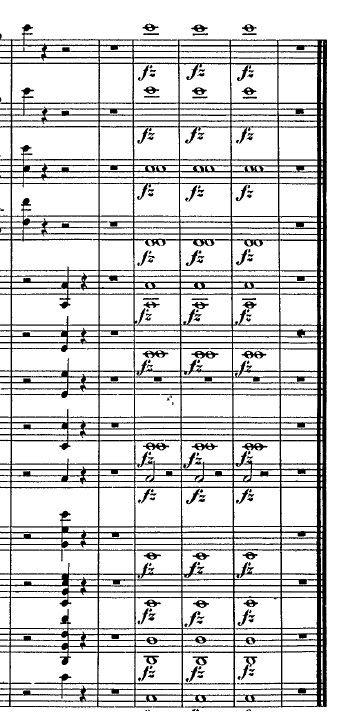
Schubert can't let go of his original idea, however, and immediately returns to revolving around the same figure he opened the movement with. But he finds a way to vary it by letting the figure become a transition that leads one of the first shifts in dynamics and feeling in the music: the woodwinds strike a rhythm ‘dada-dadada-dadada-da-da-da-da’ while the violins play a broken version of the figure that orbits but never hits the note we expect, culminating in the whole orchestra striking the note at the end:
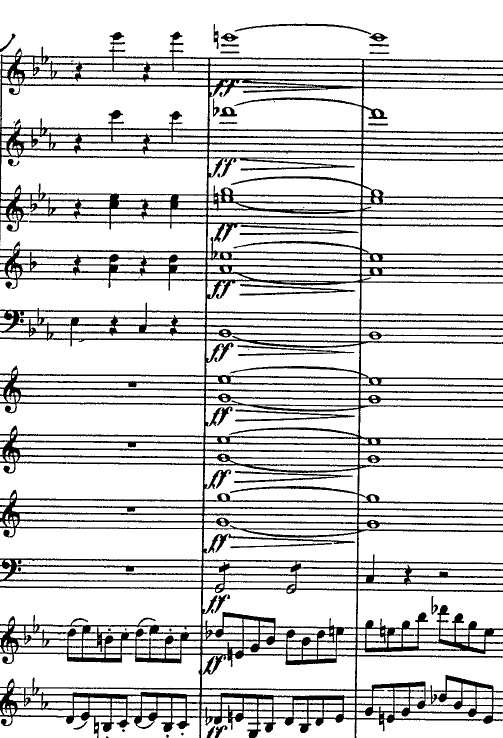
The following long piece develops this idea further, with markings in the woodwinds and fast figures in the strings, occasionally interrupted by small melodic fragments from some of the woodwinds. This piece culminates in a melody played in the woodwinds. This melody is heavily inspired by the first figure, with a motif that moves upwards before it all culminates! Or it does, because we only hear two markings, not three as we expect:
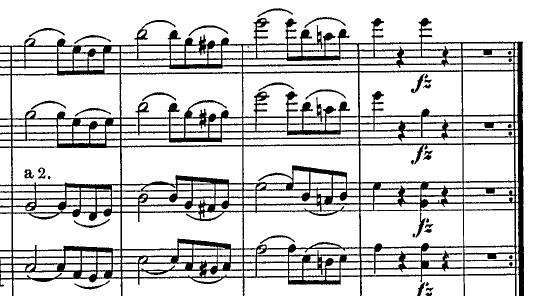
Music aficionados will notice a repeat sign at the end of the above image, and yes, this means that the whole thing we've heard so far is being played again. However, there is uncertainty as to whether this repeat sign should actually be respected, as in one original node it has been crossed out and is therefore missing in many modern versions. And you never know what the conductor's vision for the performance is, so whether it will be repeated or not is never good to know. Repetition or not, there is more music after what we've heard so far, and this begins... with a repetition:
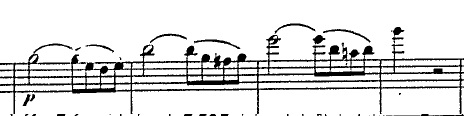
Schubert can't resist playing the figure he ended with. And it is allowed to play for a while until he finally moves on to new ideas. The tonality changes to A major and we hear a new figure that begins in the clarinet and ends in the flute:

You can hear the earlier ideas in this theme, and Schubert doesn't let it stay in this key for long either, now he moves to the parallel key of Ab major, C minor, which has the same signs but a different timbre. The theme we just heard is played again, now accompanied by a more cheerful figure in the strings:
In the next long piece, Schubert can't let go of this figure, it almost possesses the music and all instruments, takes a turn in it. Until suddenly we start to hear something familiar:
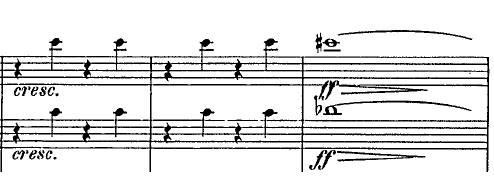
The flutes add their ‘dada-dadada-dadada-da-da-da-da-da’ and the dynamics are raised, and we get a burst of breaking out of the figure. The following piece is almost identical to the part that led up to the repeat step earlier, but this time Schubert ends it properly, not with two markings, but three - as we expect!