Ludwig van Beethoven (1770 - 1827) composed his 5th Symphony between 1804-1808. The symphony is one of the most famous pieces of music ever written. At its premiere in December 1808 with Beethoven conducting, however, it received a somewhat lukewarm reception. This was partly because the programme for this concert was over four hours long, including the first performance of Beethoven's 6th Symphony, and the orchestra had only had one real rehearsal to practice for the concert. But a year and a half later, when the work was published and music connoisseurs could begin to scrutinise the composition, it received an incredible amount of attention and soon established itself as one of Beethoven's greatest.
In the following, I will take a closer look at the first movement of the symphony.
We begin with the first theme, ‘short-short-short-short-long’, the one everyone knows, played in the strings:
In the following, I will take a closer look at the first movement of the symphony.
We begin with the first theme, ‘short-short-short-short-long’, the one everyone knows, played in the strings:
First theme

First we hear the central idea, and then Beethoven plays with it, increasing and decreasing the tempo. Then we are brought to a transition section that will bring us to the next theme:
Transition

We are taken directly to the next theme, which is a variation on the first, but here played in the horn. The theme is followed by a melodic phrase that is moved around in the woodwinds, while the strings underline the “short-short-short-short-long” idea:

The first three parts are then repeated in a slightly shortened version, but we are taken through the first theme, transition and then the second theme. After this, Beethoven begins to play around with the themes and develops them. The first theme goes like this
First theme, first variation

Now the trombone has taken over, but the strings immediately follow with all the power in the theme. Afterwards, the idea is still being played with, but there is also an underlying melody in the strings, almost an answer. Beethoven's variation on the second theme soon follows:
Second theme, first variation

Now the light strings have taken over the theme, and the rest of the string section follows, almost at a gallop, until they almost drop the theme before picking it up again.
But Beethoven soon tired of playing with the themes and returned to the first theme in its original form:
But Beethoven soon tired of playing with the themes and returned to the first theme in its original form:
First theme, second variation

However, he can't resist playing around with his orchestra, so although he doesn't change the theme, which is still played in the strings, he now lets the woodwinds accompany with melodic phrases similar to the first time we heard the second theme. Shortly after, we hear the second theme:
Other theme, other variation

This time it is played in the bassoons, which do not have the same punch as the trombones. Therefore, the interplay with the woodwinds that follows is not as contrasting, and the bassoons create a beautiful sound that underlies the melodic phrases that follow.
Now the movement begins to draw to a close, and because we have now heard the same phrases so many times, Beethoven also begins to play with our expectations, letting the orchestra play one best phrase in a circle, a little curl, perhaps once too often:
Now the movement begins to draw to a close, and because we have now heard the same phrases so many times, Beethoven also begins to play with our expectations, letting the orchestra play one best phrase in a circle, a little curl, perhaps once too often:
Curl

However, he doesn't hold us back any longer than we hear the second theme again shortly afterwards, but this time it runs into an ascending phrase and then a descending figure, which perhaps again makes us feel the whole thing is dragging on a little too long:
Second theme, third variation

The repetition isn't going anywhere... until it does, because in a masterful move, Beethoven grabs us by the nose and lets us hear a repetitive phrase that suddenly leads into something very familiar:
First theme
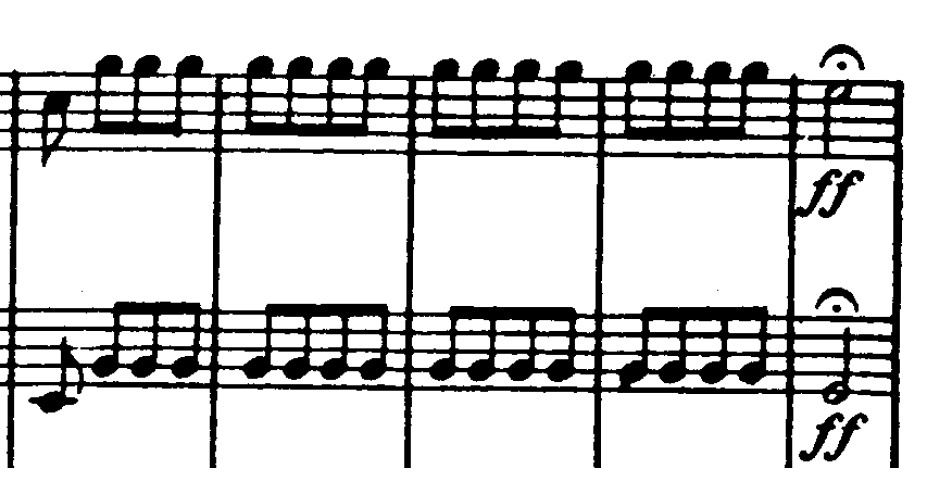
He lets the repetition function as an extended “short-short-short-short-short-short-short-short-short-short-laaaaaaaaaaaaaaaaang” and this surprise gives an almost homely feeling. We have now also reached the end of the movement and are left with the masterful theme that has travelled the world.