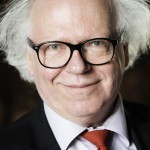
Four of the five musicians in the Danish National Symphony Orchestra's brass quintet had the same professor when they attended the conservatory. Now, with support from Venneforeningen, they have asked their old teacher to write a quintet especially for them. So right now, Professor Emeritus Mogens Andresen is getting ready for the premiere of the brass quintet entitled Brass Characters on 10 March at 13.00 in the Concert Hall. Members of the Friends are invited to the event and that's not all. Everyone is welcome to bring a guest.
And Mogens Andresen will not only present a unique piece of music. He will also talk about its creation and the history and characteristics of brass instruments, accompanied by examples that the quintet members will illustrate. If the notes are not illustration enough, the audience can see the lecture illustrated with accompanying images on a screen.
Some might think that modern brass soup is not their favourite food. But it's not just the composer's old students who praise him for his accessible, audience-friendly tonal language. He has composed, arranged and conducted many genres of music, and his compositions have caught the eye of many. The Berlin Philharmonic, for example, has commissioned several pieces from him. Mogens Andresen promises that we will cover a lot of ground on 10 March - back to the court music of Chr. 4 with smooth transitions to other and later genres. We can hear music by Gabrielli, Praetorius and Bernstein, among others.
The composer is willing to reveal a little of what he's been thinking about since he was commissioned, the first quintet from his hand.
In the piece, he will emphasise the symbolic meaning of each of the instruments
Hornet, the symbolises the sound of nature
Trombones we know as the angels' favourite instrument
Trumpets has been the proud bearer of messages throughout history, happy, serious and sad, while
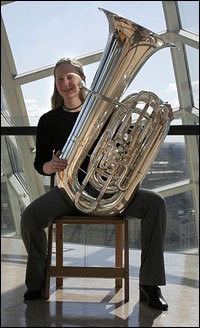
Tubas doesn't have a traditional meaning, but one that many people will associate with joie de vivre. Just think of the clown in the circus. He plays the tuba and if there are two, he trumps the other clown who has to make do with a small accordion.
Mogens Andresen has extensive experience as a performer - he started out as a military musician, as a musician in the Royal Danish Orchestra, as a teacher - professor at the Royal Danish Academy of Music, and as an arranger and composer of a wide range of works. He has arranged everything from old chorales to folk songs to military music. Mostly for brass, of course, but not alone. There is a commissioned work waiting to be performed, and it also includes percussion.
When asked if he is influenced by the genres of the military bands he has played in, conducted and arranged music for, his answer is:
-I don't really think so. I've been very inspired by folk music and have made folk song-inspired music for several Nordic countries. I'm also very attracted to Carl Nielsen's music.
At the conservatory, Mogens Andresen has taught future brass players, but has also tried to inspire them to organise music for brass ensembles, and several have taken it up, although one of them does virtually nothing but arranging today.
-You can also teach students to compose.
-No, and it's very controversial whether you should even try it. At the conservatory, students should learn to play the instrument they have and the music in front of them. The composer should preferably deviate from what has been written by others.
- Brass instruments have traditionally been music for men?
-Yes, you could say that. It's funny to think that there were no fewer than 6,000 regimental musicians in the Second Schleswig War. They were probably more soldiers than musicians. But the picture today is completely different.
-In the past, men played brass instruments and women played the harp, they were string players and later also woodwind players. In recent years, especially in the UK and the US, an increasing number of women - in some places more than half - are playing brass instruments. And the Philadelphia Orchestra is the last male bastion, The tuba, Today smoked. You can also hear a woman among the tubas in the orchestra, and many come to hear and see her.
- The style of playing has also changed. Gone are the days when brass drowned out all other instruments. For example, in Verdi's music. Brass instruments played with all their might. It's not like that today. There is a much finer balance in orchestras between the brass and the other instruments.
To hear the premiere and Mogens Andresen's lecture with music examples by the Symphony Orchestra Brass Quintet, book your tickets here. The ticket price is only 50 DKK, and remember, you can bring a guest.